 Sunday, July 26, 2026
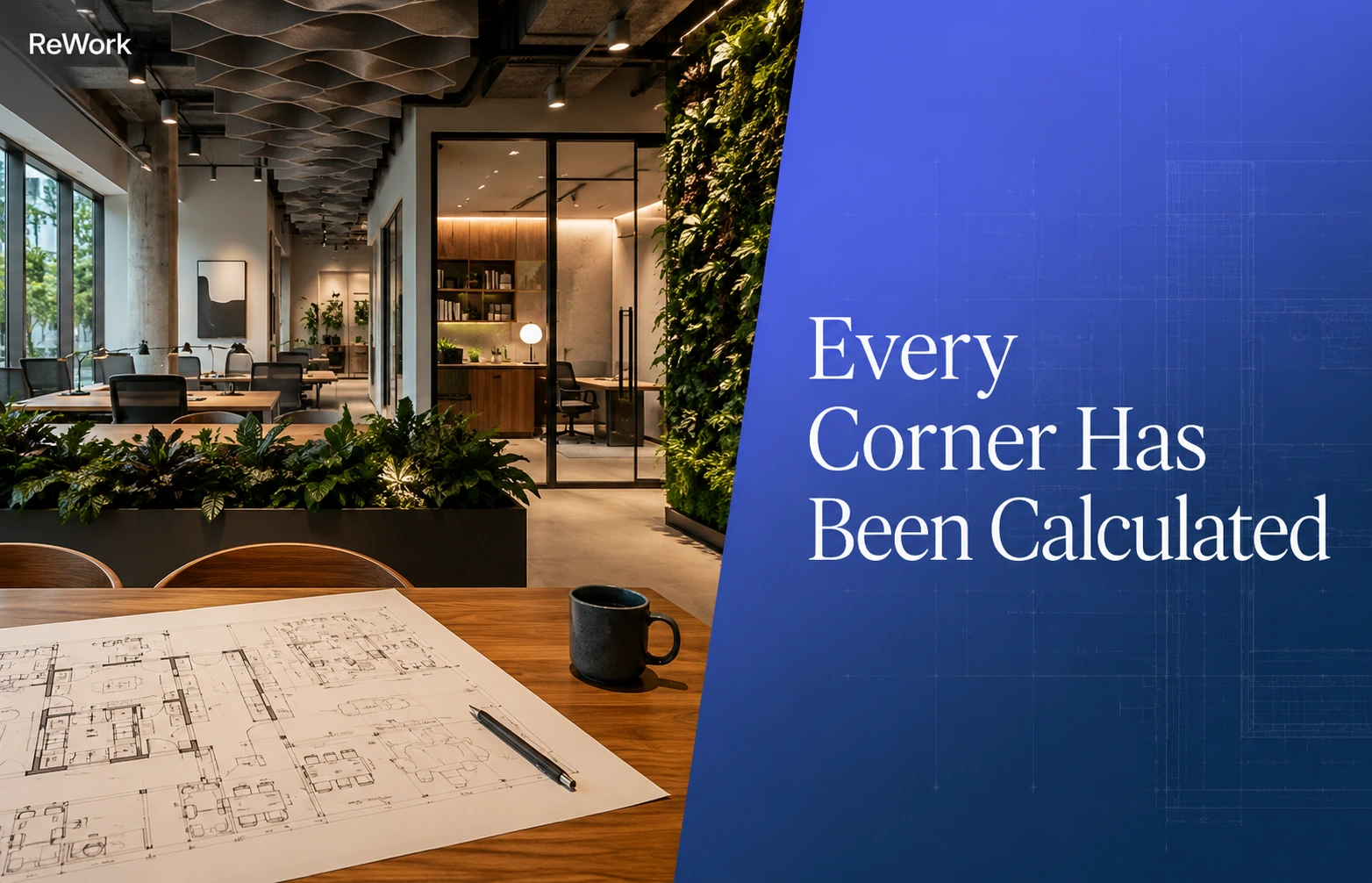
Redefining the Workplace: Every Corner of Your Office Has Been Calculated
Every Corner of Your Office Has Been Calculated. Welcome to the Science of Space Planning and Design.
Last week, in Issue #5 of the Redefining the Workplace series explored Integrated Hybrid Office Space Solutions, we answered the question of how a space should function. But that left an even more fundamental question hanging: what should the space actually look like?
This week, Issue #6 turns to Office Space Planning and Design — the category that translates organizational strategy into square meters, circulation paths, acoustic treatments, and lighting temperatures. If hybrid office solutions are the skeleton, planning and design are the nervous system and the face.
What Is Office Space Planning and Design?
Office space planning and design does not begin with a rendering. It begins with a series of deeply uncomfortable questions: how do people in this organization actually work?
R&D teams need uninterrupted deep focus. Marketing teams need high-frequency collaboration zones. Legal departments need acoustically private spaces. Place all three in the same open-plan layout without deliberate zoning, and the result is predictable — everyone suffers. True space planning starts with organizational diagnostics: employee surveys, behavioral observation, and spatial utilization data analysis to understand the real needs of people and tasks. Those needs are then translated into functional zoning, circulation logic, area ratios, acoustic schemes, and lighting strategies.
The discipline sits at the intersection of architecture, environmental psychology, ergonomics, and organizational behavior. It is a calculated process — not a matter of aesthetic preference.
At least five core dimensions define this field:
Space Strategy and Programming
This is the prequel to all design work. Without it, every subsequent drawing risks heading in the wrong direction. Steelcase, best known as a global office furniture leader, has built its true competitive moat in research rather than product: its Workplace Research team invests tens of millions of dollars annually studying how spatial environments shape human behavior, producing data on collaboration patterns, cognitive focus, and generational work-style differences that directly inform client strategy recommendations.
Herman Miller has articulated the Living Office philosophy — treating the office not as a fixed product configuration but as an activity-based spatial toolkit, matching each team’s actual collaboration patterns with appropriate settings ranging from the private Haven to the open Clubhouse.
In China, M Moser’s strategy team follows a similar logic — starting from business objectives and working backward to spatial requirements, ensuring companies understand what they genuinely need before a single dollar is spent on design. The core value of this dimension: answering what business problem this space is meant to solve, using data, before anyone picks up a pen.
Interior Design and Functional Zoning
This is the most visible dimension — the journey from floor plan to finished space. But effective workplace design goes far beyond choosing a style.
Gensler has delivered hundreds of signature workplace projects globally, applying a methodology that treats physical space as an organization’s material expression — a tech company transitioning from product-centric to platform-centric strategy, for example, might see its office design language shift from enclosed functional blocks to open connection nodes, with the space itself silently broadcasting strategic signals.
HOK, one of the world’s leading architecture firms, has designed headquarters and workplace environments for Microsoft and Samsung through its Workplace Studio, grounded in the principle that design should serve human experience — every touchpoint along the journey, from arrival to departure, is intentionally designed.
Perkins&Will operates a dedicated Human Experience research lab that draws on neuroscience and psychology to guide spatial design decisions — one of their findings: workstations with a view of greenery accelerate fatigue recovery by 15 to 20 percent.
In China, Gold Mantis, one of the country’s largest architectural decoration enterprises, has accumulated extensive design-build integration experience in the office sector. Matrix Design, listed in Shenzhen, has rapidly emerged in commercial office interiors, distinguished by its fusion of Eastern aesthetics with modern workplace requirements. LYCS Architecture, based in Hangzhou, is known for research-driven, award-winning innovative workspace design. CCD, listed in Hong Kong, has extended its expertise from luxury hospitality into the commercial office realm, bringing a hospitality-grade experience design sensibility to workplace environments.
Acoustic and Lighting Design
These are two invisible yet viscerally felt dimensions — and they consistently generate the highest volume of employee complaints. On the acoustic front, the central pain point of open-plan offices is not that others are too loud, but the absence of acoustic privacy — the mutual audibility that prevents anyone from truly focusing.
Ecophon, part of France’s Saint-Gobain Group, is the global leader in office acoustic ceiling systems, using sound absorption and diffusion principles to reduce reverberation time in open spaces from the threshold of distraction to the zone of comfort, deployed in hundreds of thousands of offices worldwide.
Interface carpet tiles also play a significant role in acoustic planning through their sound-absorbing properties. On the lighting front, mounting research confirms that Human-Centric Lighting — systems that automatically adjust color temperature and brightness to align with circadian rhythms — measurably improves afternoon cognitive performance and sleep quality.
Austrian manufacturer Zumtobel and Italian brand Artemide are at the forefront of workplace human-centric lighting, while Chinese brand OPPLE is actively advancing intelligent office lighting solutions for the domestic market.
Biophilic Design and Healthy Buildings
Placing a few potted plants in a corner is not biophilic design. The genuine application of the theory, developed by Harvard biologist E.O. Wilson, systematically integrates natural elements — light, water, vegetation, natural materials, organic forms — into the built environment, producing measurable reductions in heart rate, stress hormones, and cognitive fatigue.
The WELL Building Standard, created by Delos and administered by the International WELL Building Institute, is the global benchmark certification system in this domain, evaluating building health performance across ten dimensions: air, water, nourishment, light, movement, thermal comfort, sound, materials, mind, and community. Over four billion square feet of space worldwide have registered for or achieved WELL certification.
In China, Sino-Ocean Group has been an early adopter, with multiple office projects achieving WELL Platinum certification. M Moser has also broadly integrated biophilic design elements and WELL standards into its workplace projects.
Digital Design Tools
This dimension is fundamentally reshaping how space planning and design is practiced. Building Information Modeling has evolved from 3D modeling into a full-lifecycle digital twin platform — capable of simulating daylight performance, energy consumption, and even airflow patterns under pandemic conditions during the design phase.
VR and AR walkthrough technologies allow decision-makers to step into a future office before construction begins, experiencing scale, light quality, and circulation flow in immersive virtual environments.
Tools including IrisVR and Enscape are now widely adopted by firms such as Gensler and HOK. Further out on the frontier, computational design uses algorithms to automatically generate thousands of spatial layout options, then filters for optimal solutions based on pre-set objectives such as maximizing serendipitous collaboration touchpoints or minimizing walking distances.
Autodesk’s Generative Design platform and Rhino with Grasshopper’s parametric design tools are driving this trend.
In China, Glodon is the domestic leader in BIM technology, with its digital construction platform extending from project management into collaborative design.
Who Is Shaping This Space?
- Steelcase — Global office furniture leader, Workplace Research-driven spatial strategy, tens of millions in annual behavioral research investment
- Herman Miller — Living Office human-centered design philosophy, activity-based spatial settings
- Gensler — World’s largest architecture firm, signature workplace projects globally, annual workplace research reports
- HOK — Global architecture leader, workplace design for Microsoft, Samsung, and other multinational enterprises
- Perkins&Will — Research-driven workplace design, dedicated Human Experience neuroscience laboratory
- Haworth — Integrated furniture and spatial planning, global workplace insight research program
- M Moser — Enterprise workplace strategy, design and delivery, business-objective-driven spatial methodology
- Gold Mantis — Among China’s largest architectural decoration enterprises, integrated office design-build capabilities
- Matrix Design — Shenzhen-listed, fusion of Eastern aesthetics with modern workplace design
- LYCS Architecture — Research-driven, award-winning innovative workspace design based in Hangzhou
- CCD — Hong Kong-listed, extending hospitality-grade experience design to commercial office environments
- Ecophon (Saint-Gobain) — Global leader in office acoustic ceiling systems
- Delos / IWBI — WELL Building Standard creation and certification, four billion-plus square feet globally
- DIRTT Environmental Solutions — Modular, reconfigurable interior construction enabling rapid spatial reconfiguration
- Glodon — China’s BIM technology leader, digital construction and design platform
An important shift is underway: decision-making power in spatial planning and design is being redistributed. Historically, office design decisions were made by the administration department and senior executives — resulting in countless design failures driven by a CEO’s preference for a marble reception desk. Data is now seizing the narrative: real occupancy sensor data tells companies that their employees never actually use that stylish lounge area, yet they queue daily for the two small four-person meeting rooms. This means the future workplace designer must not only draw but also read data — the hybrid skill set of design plus data analytics is becoming the most scarce and valuable competency in this industry.
Simultaneously, Chinese design capabilities are rising rapidly. Firms such as Gold Mantis, Matrix Design, LYCS Architecture, and CCD are no longer merely serving as local execution partners for international practices but are leading original spatial design — particularly in understanding the nuances of Chinese organizational collaboration culture, such as the outsized role informal communication plays in Chinese enterprises, an insight that international firms cannot replicate.
Why Does This Matter for ReWork?
If Issue #5’s Integrated Hybrid Office Space Solutions provided the skeletal framework of ReWork — defining the operational logic and combinatorial principles of the exhibition space — then Office Space Planning and Design represents its face and nervous system. It determines what the space looks like, how it feels to move through, and whether being inside it is a pleasure or a punishment.
At ReWork, this content will not remain confined to display boards. The outcomes of spatial planning and design will be presented in the most immediate way possible: the circulation paths you walk, the workstations where you sit, the ceiling above your head, the quality of light on every surface. The entire ReWork exhibition area is, in itself, an exhibit of office space planning and design.
At ReWork this October, expect:
- Full spatial planning logic on display — revealing the reasoning behind every design decision: why the deep-focus zone occupies this corner, why the collaboration area sits adjacent to the coffee bar, why meeting rooms are positioned away from windows
- Multiple design-language office scene buildouts — the dynamic, energetic style favored by tech companies, the composed, professional aesthetic of financial institutions, and the experimental, freeform approach of creative agencies — identical square footage, radically different spatial outcomes
- An acoustic experience pod — your body registers the difference before your ears do
- A biophilic design immersion zone — an immersive demonstration of what the WELL standard means when it describes a healthy building
- VR and AR spatial walkthroughs — experiencing firsthand how technology transforms spatial design from guesswork into informed decision-making
Coming next week: Issue #7 — ESG and Sustainable Office Environments. Having covered how space functions and what it looks like, the next question is even larger: is this space good for the planet? From carbon-neutral workspaces to green building materials, from LEED and WELL certification to the E and S in ESG reporting — why sustainable office design is rapidly shifting from a nice-to-have to a non-negotiable.
Event Details
Exhibition: RemaxWorld Expo 2026 (20th Anniversary)
Feature Zone: ReWork – Greater Bay Area International Exhibition for Office Space & AI Office Solutions
Dates: October 15-17, 2026
Location: Zhuhai International Convention and Exhibition Center
Stay tuned. The future of work unfolds every Monday.
Pre-registration is open! REGISTER NOW to secure your spot at the show.
For questions or more information, contact us at RemaxWorld@RTMworld.com
We look forward to welcoming global industry professionals to Zhuhai.

Related:
Redefining the Workplace: Your Office Is No Longer Just a Room
The AI Battlefield Is No Longer Confined to the Office
Redefining the Workplace: Your Desk Is Now Smarter Than You Think
Redefining the Workplace: Your Colleague Might Not Be Human Anymore
Redefining the Workplace: Your Mouse Just Got a Whole Lot Smarter
AI + Space: The Future of Work
RemaxWorld 2026: A New Chapter Begins
Celebrating the Success of RemaxWorld Expo 2025
Industry Future Discussed on Day 2 of RemaxWorld Summit 2025
RemaxWorld Summit 2025 Sparks Global Dialogue in Day One
13 Winners Announced for RT Global Imaging Industry Award 2025
Thousands Gather for Innovation and Networking at RemaxWorld Expo 2025
RemaxWorld Expo 2025 Is Ready to Welcome You!
10-Day Countdown Checklist for RemaxWorld Expo 2025
Surprises Never End as RemaxWorld Countdown Closes to End
Industry Views from RemaxWorld Expo Global Visitors
Free Lunch On Us, VIP Fun For You, and Hotel Picks!
30 Days to THE SHOW! Theme for This Week Lucky Draw Unveiled!
Explore Top Exhibitors and Innovations at RemaxWorld Expo 2025
Amazon to Share Global Vision for the Future Workplace at RemaxWorld Summit 2025
Countdown to the SHOW – 6 Weeks of Surprise Gifts Starts Today!
AI is Reshaping the Future of Printing
Your Travel Guide to RemaxWorld Expo 2025 in Zhuhai
First Wave of Exhibitors at the World’s Largest Printing Expo Revealed
Unlock Your VIP Benefits at the Printing Industry’s Biggest Event – RTM World
Hotel Booking Now Open for RemaxWorld Expo 2025!
Big Rewards Are Coming This August!
Final Day to Nominate for the RT Global Imaging Industry Awards
Visitor Interview|Changing Russian Printing Market
Visa-Free Entry to China Now Easier Than Ever
RT Global Imaging Industry Awards Call for Nomination
Nominations Now Open for the 2025 RT Global Imaging Industry Awards
Comment:
Please add your comment below about this news story, “Your Office Is No Longer Just a Room”.



Leave a Comment
Want to join the discussion?Feel free to contribute!