 Sunday, July 5, 2026
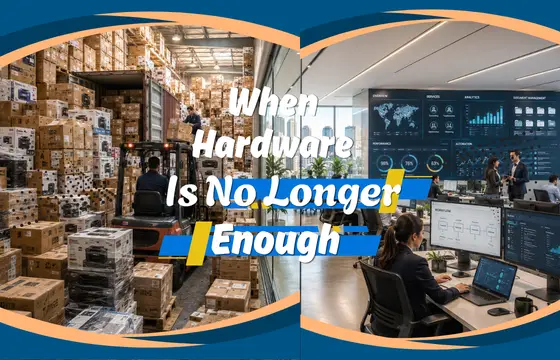
When Hardware Is No Longer Enough
As OEMs accelerate their transition toward services, automation, and technology integration, aftermarket manufacturers and distributors are beginning to face an uncomfortable question: are they prepared to compete in a market where selling hardware no longer seems enough?
For years, much of the printing industry built its competitiveness around hardware. Speed, cost per page, print quality, reliability, availability, and operational efficiency were among the pillars that shaped the market for decades.
But over the past few months, a series of signals seems to point toward a deeper shift.

Financial reports from Japanese manufacturers, new frameworks from global consulting firms, and even announcements related to artificial intelligence are increasingly repeating concepts that until recently played a much smaller role in the industry: automation, integration, workflow, recurring services, and productivity.
Hardware remains important. But it increasingly feels insufficient on its own.
Value Is Starting to Shift
Manufacturers such as Xerox, Konica Minolta, Kyocera Corporation, Sharp Corporation, and Toshiba Tec increasingly seems to be moving in the same direction: less dependence on traditional hardware and greater emphasis on services, automation, operational efficiency, and recurring business.
This is not only about technology. It also appears to be a response to a structural challenge: sustaining growth, profitability, and differentiation in a market where hardware is becoming increasingly commoditized.
And yet, it would be a mistake to interpret this as the end of the printing business.
Printing will likely remain relevant across several sectors. Government, education, healthcare, banks, and financial institutions still depend on hybrid document environments, traceability, physical validation, and operational workflows where paper continues to play a meaningful role.
Perhaps the real shift is not the disappearance of print, but the gradual movement of value toward new layers of the business.
The Aftermarket’s Historical Resilience
That transition is especially sensitive for the aftermarket.
If the aftermarket has demonstrated anything over the past decades, it is resilience. The industry has survived patent wars, OEM pressure, digitization, channel consolidation, and declining print volumes — often adapting with remarkable speed.
But almost always through the product itself.
Compatibility, availability, logistics, technical support, efficiency, and operational cost have historically been some of its main competitive strengths.
The next phase of resilience may no longer be built around product alone.
The Next Transition
Across many Latin American markets, signs of transition are already visible. Numerous distributors and independent channels have evolved from simply selling supplies to offering leasing contracts, MPS, CPP, and managed print services.
In many ways, they stopped selling only products and started selling operational continuity.
Still, the next stage appears more complex.
The growing importance of document automation, workflow integration, analytics, cloud platforms, and AI-driven tools is moving the conversation toward areas historically dominated by OEMs and large technology companies.
Part of the Solution?
And this is where an uncomfortable question begins to emerge for part of the global aftermarket.
While the industry increasingly talks about services, integration, and productivity, much of the aftermarket supply chain still appears heavily focused on volume, price competition, and commercial pressure around hardware and supplies.
Perhaps the real challenge for the aftermarket is no longer simply offering a lower-cost alternative.
The question is whether manufacturers and suppliers will be able to follow this transition — and become part of the solution as well.
This does not necessarily mean the aftermarket will be left behind. Latin America remains an extremely cost-sensitive region, with longer replacement cycles and a strong culture of reuse, repair, and operational optimization. In that environment, independent channels still retain important advantages.
But a new tension does seem to be emerging: the possibility that the industry’s next evolution may no longer depend only on printing better or cheaper.
The real challenge may be finding how to capture value in a market that is beginning to redefine what a “solution” actually means.
And that conversation is probably just beginning.
These shifts will be among the key discussions at the upcoming RemaxWorld Summit 2026. Stay tuned.
 About the Author
Gustavo Molinatti is an editor and consultant specializing in the printing and aftermarket industry in Latin America. For more than two decades, he has developed media platforms, events, content, and business projects related to printing, consumables, and document management.
He is the founder of Blog del Reciclador, considered the most widely read Spanish-language print aftermarket media outlet worldwide, and actively participates in international initiatives and events related to the print and imaging industry.
He currently advises manufacturers and international companies on expansion strategies, channel development, and business opportunities across Latin American markets.
He can be reached at gmolinatti@guiadelreciclador.com
Read other articles by Molinatti:
- 2025 in Review: Key Industry Trends and What to Watch in 2026
- Market Analyst Shares Key Insights for Latin America in 2025
- Global Logistics and Its Impact on Latin America
- The Growth of Inkjet: New Normal or Temporary Bubble?
- Revealing the True Latino Pioneering Spirit
- Show Me the Color in Latin America
- Remanufacturing Remains Viable in Latin America
- Price Quality or Service – or all Three?
- Vertical Integration in the Latin Aftermarket: the Next Step?
- Adapting to New Normality or a Paradigm Shift?
- Can Latin America Manufacture its own NBCs—and be Profitable?
- HP Blocks Online Sale of Aftermarket Cartridges
- Remembering when Product Sales Increased
- Confronting Market Challenges and Opportunities
Comment:
Please leave your comments below for the story “When Hardware Is No Longer Enough.”



Leave a Comment
Want to join the discussion?Feel free to contribute!