 Monday, July 6, 2026
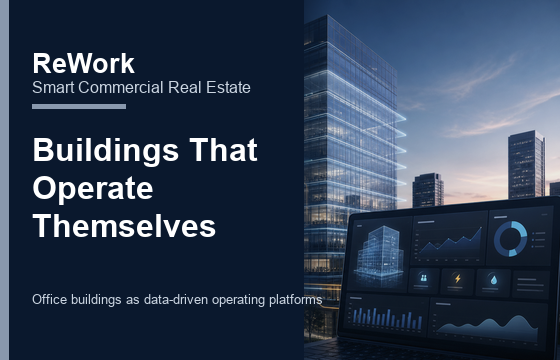
Redefining the Workplace: Buildings Are Learning to Operate Themselves
Last week, Issue #7 of the Redefining the Workplace series explored ESG and Sustainable Office Environments — from green building certifications and carbon data to circular materials and employee wellbeing. But one practical question remains: who actually makes these ambitions work every day? This question leads to the topic for this week – Smart Commercial Real Estate for the Office: Buildings Are Learning to Operate Themselves.
The answer is not a rendering, nor a sustainability paragraph in an annual report. It is the building owner, property manager, leasing team, facility operator, asset manager and investor who must keep the building open, comfortable, efficient, leased, compliant and valuable.
As office vacancy, tenant experience, energy costs, asset valuation and ESG reporting converge on the same dashboard, traditional property management is no longer enough. Commercial real estate is moving from managing buildings to operating assets; from looking at square meters to reading data. This week, Issue #8 turns to Smart Commercial Real Estate for the Office — the category that sits behind the scenes, connecting workplace technology, building operations and asset value.
What Is Smart Commercial Real Estate for the Office?
Smart Commercial Real Estate for the Office refers to the integration of IoT, building automation, digital twins, spatial data, tenant experience platforms, asset management systems and AI analytics across the full lifecycle of office buildings: development, leasing, operation, maintenance and portfolio management.
Traditional office buildings were measured by familiar indicators: location, floor area, rent, occupancy rate, building age and hardware quality. Smart commercial real estate asks more detailed questions. Which floor has the highest foot traffic? Which meeting rooms are booked but not used? How much energy is wasted by the HVAC system every hour? Is a tenant’s renewal risk already visible through access control, service requests and satisfaction data? Could one underused floor become a shared meeting center and improve the building’s overall yield?
In short, the office building is evolving from a concrete asset into a data-driven operating platform. It serves not only tenants, but also owners, property teams, leasing teams, asset managers, investors and urban operators.
Five dimensions define this field:
Smart Buildings and Building Automation
This is the foundation. If a building cannot sense where people are, which zones are overheating, which floors are underused, or which equipment is consuming abnormal amounts of energy, every AI promise that follows is empty. Smart building systems connect sensors, access control, elevators, HVAC, lighting, security and energy devices into a unified operating platform. Schneider Electric’s EcoStruxure Building, Siemens Building X, Johnson Controls OpenBlue and Honeywell Forge for Buildings are representative platforms in this space. Their value is not simply connecting equipment. It is allowing a building to respond to real use: providing comfort when people are present, reducing energy use when spaces are empty, and warning facility teams before a problem becomes a tenant complaint.
Digital Twins and AI Operations
A digital twin turns a real office building into a visual, analyzable and simulatable digital version. It can display space utilization by floor, equipment status, energy curves, movement patterns and maintenance records. It can also simulate what happens if a floor is converted into a flexible workspace or shared amenity area. Microsoft Azure Digital Twins, Autodesk Tandem, Bentley iTwin and Matterport are helping move buildings from static drawings into dynamic operating models. With AI, the system goes further: it does not merely show data, but suggests action. Which equipment should be serviced early? Which floors need a leasing strategy adjustment? Which tenant mix best fits this building? Future asset managers will not only read spreadsheets. They will operate live digital buildings.
Space Utilization and Tenant Experience
Commercial real estate used to focus heavily on occupancy rate: once the space was leased, the job was largely done. Hybrid work has changed the question. Leased does not necessarily mean used. Before reducing space, tenants now ask: how much of our office do we actually use? Which days bring employees back? Are meeting rooms truly insufficient, or are they blocked by unused bookings? Companies including VergeSense, Density, XY Sense, Cisco Spaces and Spacewell use occupancy sensing, Wi-Fi location data, reservation systems and workplace analytics to help enterprises and building owners understand real space demand. For owners, this data has direct commercial value. It can help tenants optimize footprints, and it can help buildings convert underused areas into shared meeting rooms, event spaces or enterprise service centers. The business model shifts from collecting rent to delivering services.
PropTech and Asset Management Platforms
Commercial real estate digitization does not happen only inside the building. It also reshapes leasing and asset management. JLL, CBRE, Cushman & Wakefield and Colliers are combining advisory, leasing, property management, ESG and data services into more integrated asset solutions. On the software side, Yardi, MRI Software, VTS, Building Engines, Planon and Ming Yuan Cloud cover lease management, customer relationships, service requests, spatial data, financial analysis and portfolio management. In the past, building operations relied heavily on experience and relationships. Today, owners increasingly want to understand the return behind every floor, every tenant and every service. Commercial real estate is becoming not only a capital-intensive industry, but a data-intensive one.
Smart Campuses and City-Level Office Ecosystems
When intelligence expands from a single office tower to a campus, business park or urban district, commercial real estate enters a larger ecosystem. Smart campuses manage more than access control, parking, energy and security. They also manage enterprise services, visitor systems, conference centers, dining, events, commuting and leasing profiles. Chinese companies including Huawei, Alibaba Cloud, Tencent Cloud, Onewo and SenseTime have accumulated extensive practice in smart campuses, building IoT, visual sensing, energy management and digital operations. The future value of office commercial real estate will not depend only on whether a building is good. It will depend on whether its surrounding ecosystem can support business growth: talent, transportation, amenities, policy resources, events and industrial networks.
Who Is Shaping This Space?
- Schneider Electric — EcoStruxure Building for digital building operations, energy optimization and equipment management
- Siemens — Building X smart building platform for automation, energy analysis and building data integration
- Johnson Controls — OpenBlue digital platform for HVAC, security, energy performance and building operations
- Honeywell — Forge for Buildings, focused on commercial building operations, energy and comfort management
- Microsoft — Azure Digital Twins, connecting buildings, devices, spaces and operating data
- Autodesk — Tandem digital twin platform extending BIM data into building operations
- Bentley Systems — iTwin platform for infrastructure and building asset digital twins
- Matterport — spatial digitization and 3D capture platform
- VergeSense, Density and XY Sense — workplace utilization and occupancy analytics
- Cisco Spaces — location-based space experience, occupancy analytics and indoor positioning
- Spacewell and Planon — smart workplace, facilities management and building operations software
- JLL — global commercial real estate services with technology, advisory, property management and sustainability capabilities
- CBRE — global commercial real estate services across leasing, asset services, workplace strategy and data analytics
- Cushman & Wakefield — commercial real estate consulting, property and facility management, workplace strategy
- Colliers — investment management, leasing, project management and commercial real estate advisory
- Yardi, MRI Software and VTS — digital platforms for property management, leasing and portfolio operations
- Building Engines — commercial property operations platform for work orders, tenant service and building management
- Ming Yuan Cloud — digital service provider for China’s real estate ecosystem
- Huawei, Alibaba Cloud and Tencent Cloud — important providers of smart campus, IoT, cloud and data platform capabilities in China
- Onewo — Chinese property and space technology service provider across residential, commercial and urban spaces
- SenseTime — visual AI, spatial sensing and smart campus solutions
A major shift is underway: the value of commercial real estate is moving from location plus area to location plus area plus data capability. In the past, the competitiveness of a Grade-A office building mainly depended on location, transportation, hardware, property service and rent. Today, tenants ask more detailed questions. Can the building support hybrid work? Can it provide space utilization reports? Can it help with ESG data? Can employees handle visitors, meeting rooms, parking and service requests on mobile? Can underused areas be converted into flexible services rather than forcing a tenant to sign long-term space it may not need?
That means owners are competing differently. Those who understand real usage data faster can design better services. Those who see energy and equipment status clearly can control operating costs more effectively. Those who connect ESG, tenant experience and space efficiency have a stronger chance of protecting asset value in a stock-heavy office market.
The future commercial real estate owner is not only a landlord. It is increasingly the product manager of an office ecosystem.
Why Does This Matter for ReWork?
ReWork is not only about what products appear inside an office. It asks a broader question: how will future office spaces be built, operated and continuously renewed?
Smart Commercial Real Estate for the Office sits at the highest operational layer of that question. The AI devices, collaboration software, smart meeting systems, intelligent furniture, hybrid spaces, spatial design and ESG practices explored in previous issues all eventually enter real buildings and campuses, where owners, property teams, tenants and service providers must operate them together.
If AI office devices are tools, office space design is the scenario, and ESG is the baseline, then smart commercial real estate is the operating system that connects them.
At ReWork this October, expect:
- A smart building operations cockpit — a large-screen simulation of an office building’s real-time status, including foot traffic, energy use, meeting room utilization, equipment alerts, air quality, parking and visitor data
- A digital twin office tower demonstration — rotate, zoom and switch floors in a virtual building to view space utilization, equipment status and energy performance
- A space utilization experiment zone — simulated sensor data from workstations, meeting rooms and collaboration zones showing the gap between leased space and actual use
- A commercial real estate asset operations scenario — from leasing, contracts and service requests to energy, tenant satisfaction and renewal risk, showing how owners manage office assets on one platform
- A smart campus ecosystem model — connecting office towers, commuting, parking, visitors, conference centers, dining and enterprise services into one operating environment
Coming next week: Issue #9 — Flexible Business Space Operations. Once office buildings can operate intelligently, the next question is whether space can be sold and used more flexibly. From coworking spaces to enterprise satellite offices, from seat-based pricing to service-based revenue, we will explore how flexible business space is reshaping the office real estate business model.
Stay tuned. The future of work unfolds every Monday.
Event Details
Exhibition: RemaxWorld Expo 2026 (20th Anniversary)
Feature Zone: ReWork – Greater Bay Area International Exhibition for Office Space & AI Office Solutions
Dates: October 15-17, 2026
Location: Zhuhai International Convention and Exhibition Center
Stay tuned. The future of work unfolds every Monday.
Pre-registration is open! REGISTER NOW to secure your spot at the show.
For questions or more information, contact us at RemaxWorld@RTMworld.com
We look forward to welcoming global industry professionals to Zhuhai.

Related:
Three Standout Categories of RT Global Imaging Industry Awards 2026
Redefining the Workplace: Your Office Is No Longer Just a Room
The AI Battlefield Is No Longer Confined to the Office
Redefining the Workplace: Your Desk Is Now Smarter Than You Think
Redefining the Workplace: Your Colleague Might Not Be Human Anymore
Redefining the Workplace: Your Mouse Just Got a Whole Lot Smarter
AI + Space: The Future of Work
RemaxWorld 2026: A New Chapter Begins
Celebrating the Success of RemaxWorld Expo 2025
Industry Future Discussed on Day 2 of RemaxWorld Summit 2025
RemaxWorld Summit 2025 Sparks Global Dialogue in Day One
13 Winners Announced for RT Global Imaging Industry Award 2025
Thousands Gather for Innovation and Networking at RemaxWorld Expo 2025
RemaxWorld Expo 2025 Is Ready to Welcome You!
10-Day Countdown Checklist for RemaxWorld Expo 2025
Surprises Never End as RemaxWorld Countdown Closes to End
Industry Views from RemaxWorld Expo Global Visitors
Free Lunch On Us, VIP Fun For You, and Hotel Picks!
30 Days to THE SHOW! Theme for This Week Lucky Draw Unveiled!
Explore Top Exhibitors and Innovations at RemaxWorld Expo 2025
Amazon to Share Global Vision for the Future Workplace at RemaxWorld Summit 2025
Countdown to the SHOW – 6 Weeks of Surprise Gifts Starts Today!
AI is Reshaping the Future of Printing
Your Travel Guide to RemaxWorld Expo 2025 in Zhuhai
First Wave of Exhibitors at the World’s Largest Printing Expo Revealed
Unlock Your VIP Benefits at the Printing Industry’s Biggest Event – RTM World
Hotel Booking Now Open for RemaxWorld Expo 2025!
Big Rewards Are Coming This August!
Final Day to Nominate for the RT Global Imaging Industry Awards
Visitor Interview|Changing Russian Printing Market
Visa-Free Entry to China Now Easier Than Ever
RT Global Imaging Industry Awards Call for Nomination
Nominations Now Open for the 2025 RT Global Imaging Industry Awards
Comment:
Please add your comment below about this news story, “Redefining the Workplace: Buildings Are Learning to Operate Themselves”.





Leave a Comment
Want to join the discussion?Feel free to contribute!