 Sunday, July 26, 2026
How AI Is Rewriting the Rules of Office Printing
For decades, office printing followed a stable model: sell the hardware, earn recurring revenue from consumables, and support everything with service contracts. That model is still in place, but AI is starting to change how it works.
The big shift is not just that fewer pages are being printed. That trend has been happening for years. The real change is that AI can now make decisions about documents before they are printed. It can decide whether a document should be printed at all, how it should be formatted, who can access it, and how it moves through the workflow.
What happens when printers start thinking for themselves?

That means the printer is no longer just an output device. It is becoming part of a broader document system that manages, routes, secures, and analyzes information.
AI is increasingly built directly into multifunction printers (MFPs), turning them into intelligent endpoints. The key integrations will be:
- Embedded AI chips/firmware: to optimize print quality, toner usage, and calibration in real time
- User behavior learning: where devices learn typical print patterns and adjust defaults automatically
- Biometric / proximity authentication: including facial recognition, badge tap, or mobile unlock to release jobs
- On-device document analysis: to detect sensitive content before printing
- Smart print queues: where AI routes jobs to the most efficient device
- Policy enforcement: to automatically apply rules (duplex, grayscale, restricted printing)
- Anomaly detection
Control shifts from users to centralized, AI-driven orchestration. The printer is no longer passive. It actively participates in decision-making and control. It is becoming a managed outcome, shaped by algorithms designed to optimize cost, efficiency, and sustainability
AI-enabled systems can now evaluate documents before they are printed, recommending digital alternatives when appropriate or reformatting content to reduce page count and ink usage. A presentation that might once have been printed in full color across dozens of pages can be automatically condensed. Or not printed at all.
At the same time, multifunction printers are evolving into document processing hubs. They can automatically interpret structure, classify content, and route documents into workflows. The printer, in effect, is becoming part of the organization’s digital nervous system.
Where exactly does AI fit in?
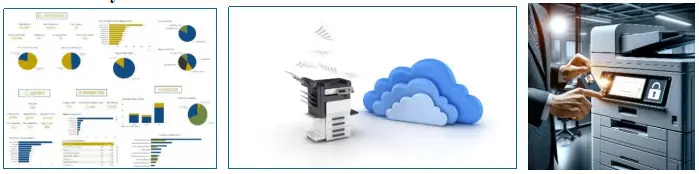
AI is being built into printers, print management software, document workflows, cloud services, and security systems. At the device level, it can improve print quality, reduce toner use, and adjust settings automatically. In the workflow layer, it can scan documents, classify content, and route files to the right system.
This is where AI has the most immediate impact today. The Key integrations will be:
- Advanced OCR + semantic understanding
- Extracts meaning, not just text
- Auto-classification & tagging
- Recognizes invoices, contracts, forms
- Workflow automation
- Routes documents to ERP, CRM, or cloud storage
- Translation & summarization
- Converts documents across languages instantly
Printing becomes just one step in a broader intelligent document pipeline.
At the device level, printers now include embedded intelligence that optimizes output quality, monitors usage, and even enforces security protocols.
Above that sits the print management layer, where AI routes jobs, enforces policies, and analyzes usage patterns across the organization.
Beyond this is the document workflow layer, where AI extracts meaning from scanned documents, classifies them, and integrates them into enterprise systems such as ERP or CRM platforms.
In the cloud, AI enables predictive maintenance, automated supply chains, and fleet-wide optimization across multiple locations.
It can also support security by flagging sensitive information before printing and by applying access controls such as a badge, mobile device, or biometric authentication. In practice, that turns the printer into a managed endpoint rather than a passive machine.
Could a printer fix itself before it breaks?
Behind the scenes, some of the most important changes are taking place. AI is also changing how printers are maintained and supported. Predictive maintenance can spot problems before they cause downtime. Automated supply systems can reorder toner based on usage. Fleet management tools can shift jobs between devices to improve efficiency.
This is pushing the industry away from the old break-fix model and toward ongoing service. For customers, that means less disruption. For providers, it means more value coming from software, analytics, and support.
AI is deeply integrated into cloud-based print ecosystems. The Key integrations will be:
- Predictive maintenance: where it detects failures before they occur
- Automated supply chain: they can triggers toner/ink orders based on usage patterns
- Remote fleet optimization: balance workloads across locations
- Usage analytics at scale: enterprise-wide insights and benchmarking
Printing becomes a managed, data-driven service, not a local activity.
Predictive maintenance allows devices to detect early signs of wear and trigger service interventions before failures occur. Consumables are replenished automatically based on actual usage patterns. Print jobs are routed in ways that reduce mechanical stress and energy consumption.
This fundamentally alters the economics of service. The traditional break-fix model begins to fade, replaced by continuous monitoring and proactive support.
For the end user, printing simply works. For providers, however, it requires a shift toward data-driven service delivery.
Who controls the document at the moment it’s printed?
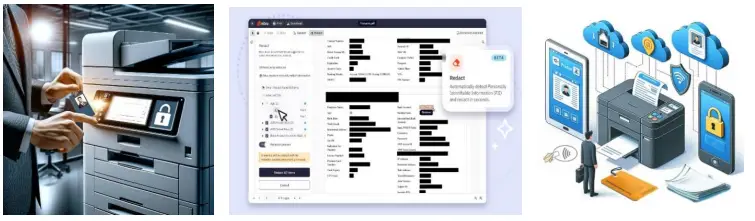
Printing is becoming more tightly connected to security. AI can identify confidential information before a page is printed and create a full audit trail of who printed what. In regulated industries, that makes the printer part of compliance rather than a weak point in the system. As printing becomes more intelligent, control becomes more critical. AI is now embedded in print security frameworks.
The key integrations we will see include:
- Content scanning before print: detecting PII, financial data, or confidential terms
- Automated redaction: to remove sensitive content before printing
- User authentication & tracking: providing full audit trail of who printed what
- Threat detection: identifying abnormal or risky behavior
How will users interact with the systems of the future?
There will be a number of different ways in which AI is changing how users interact with printing.
- Natural language print commands: Eg “Print this as a two-page summary in black and white
- AI assistants: suggesting alternatives to printing
- Mobile-first interaction: where users can print, scan, and manage jobs from smartphones
- Context-aware suggestions: recommend best format, printer, or timing
Printing will become intent-driven, not task-driven
What does this mean for the traditional business model?
For the business equipment and supplies industry, the implications are profound.
Consumables, which have been the long-term foundation of profitability, will come under pressure as AI reduces usage and digital workflows replace physical output. Hardware lifecycles are extending, and replacement cycles are slowing.
At the same time, printers themselves are being repositioned. They are no longer standalone products, but platforms within a broader solution.
This creates a clear divide in the market: those who remain focused on products, and those who evolve into providers of integrated, AI-enabled services.
Where will future revenue come from?
The answer lies increasingly in services and software.
AI enables providers to offer subscription-based solutions that include predictive maintenance, compliance monitoring, workflow automation, and analytics. These recurring revenue streams provide stability and align with how customers now prefer to buy technology.
The emphasis shifts from selling devices to delivering outcomes—efficiency, security, reliability, and insight.
For distributors and dealers, this means shifting focus from hardware margins to service-led offerings such as MPS, workflow solutions, and analytics.
How will AI impact sustainability?
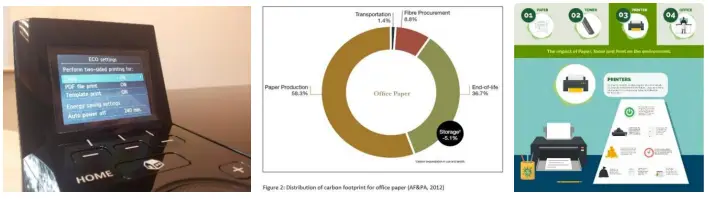
AI makes it possible to measure the environmental impact of printing with precision. Organizations can track carbon output, reduce waste automatically, and align printing practices with broader ESG objectives.
For suppliers, this is both a challenge and an opportunity. Those that can demonstrate measurable environmental benefits will be better positioned in competitive markets.
AI will make printing more measurable from an environmental perspective. It can recommend duplex printing, grayscale output, and lower-waste settings. It can also track usage and help organisations report on carbon impact.
AI will operate across five interconnected layers:
- Device intelligence (smart printers)
- Control systems (print management software)
- Workflow intelligence (document processing)
- Cloud services (MPS and analytics)
- Security & sustainability overlays
These layers will be tightly integrated, creating a closed-loop system where:
- Data is continuously collected
- AI models optimize behavior
- Systems adapt automatically over time
For many buyers, sustainability is no longer a side issue. It is part of procurement, compliance, and brand reputation.
The business impact
The industry is not disappearing, but it is changing shape. Revenue from consumables is under pressure as print volumes fall and digital workflows expand. At the same time, demand is growing for software, monitoring, workflow automation, and managed print services.
That creates a clear divide. Companies that only sell products will feel the squeeze. Companies that offer integrated services will be better placed to grow.
In the near term, AI capabilities such as document triage, predictive maintenance, and intelligent routing will become standard. Over the next three to five years, more advanced features—real-time compliance enforcement, multilingual document processing, and carbon tracking—will be widely adopted.
The pace may vary, but the direction is clear.
In practical terms, the “printer” will no longer be the center of the system.
The AI layer is.
About the Author
 Graham J. Galliford is a world-renowned consultant to the imaging industry. His work has encompassed the technology of all types of printing products but has been focused on toner-based printing technology since 1974. He founded Galliford Consulting & Marketing, a techno-commercial consulting business concerning toner-based imaging processes, in 1994. The firm’s particular emphasis is on digital printing with electrostatic toner.
Operating from a unique facility for R&D on digital printing materials his business has completed many projects concerning the formulation, manufacture, application and marketing of these products. Galliford has been a regular speaker at conferences in North America, Europe and Asia on all aspects of the digital printing and the toner business from technology to marketing to manufacturing. He has made over 80 presentations to industry gatherings over the last 30 years, including seminars on digital printing technologies and chemically prepared toner technology and markets. He can be contacted by email at graham@ gallifordconsulting.com
Related:
- Canon’s U.S. Remanufacturing Initiative and Industry Implications
- Toner Cartridge Manufacturers Guarantee Great Color for Their Customers
- The Role of a Bill of Materials in Costings and Pricing
- Digging Deeper into Inkjet Ink Market Share
- Manufacturing Color Toner – Who How and Where
- Supply Chains and Market Integration
- Debate: Toner & Laser Supplies Will Continue to Dominate
- Testing Cartridge Components and Meeting Standards
- The Controversy Over Cartridge “Contaminants” – An Attempt to Avoid Bias
- Facts and Lies over the Toxins in Your Printer Cartridges
- Why Most OEMs Are Japanese
Comment:
Please comment below about this feature article, “How AI Is Rewriting the Rules of Office Printing.”


Leave a Comment
Want to join the discussion?Feel free to contribute!