 Tuesday, July 14, 2026

Canon’s U.S. Remanufacturing Initiative and Industry Implications
Canon Inc. and Canon U.S.A., Inc. are launching a remanufacturing program in the U.S. By remanufacturing printers, Canon aims to shift the structure of the office equipment industry by reclaiming this sector from third-party and aftermarket refurbishers and exporters.
Starting in April 2026 at Canon Virginia’s Newport News, the facility will treat returns not as end-of-life equipment but as inputs for a second production cycle. The company’s profile will be advanced by the circular manufacturing for printers and copiers.
OEM-led remanufacturing is not entirely new. Several major manufacturers have operated similar programs for years, particularly outside the United States. This includes Ricoh’s GreenLine, Xerox’s certified printers, and Konica Minolta’s efforts. However, the scale of Canon’s domestic initiative within the United States is unique.
Strategic Benefits
By regaining OEM control over the secondary lifecycle, Canon will protect its IP, ensure quality, and capture value from the aftermarket refurbishers. Vertical integration uses proprietary diagnostics and telemetry to achieve 90%+ parts reuse on factory lines, unlike dealer refurbishment. This extends lifecycles from 5 to 8-10 years, boosts Managed Print Services (MPS) profitability with cheaper hardware, and meets sustainability demands.
Remanufactured devices will offer full warranties, new consumables (drums, rollers), lower prices, and MPS availability.
Canon is treating remanufacturing as a core manufacturing capability rather than an outsourced aftermarket service. This will bring a new level of respectability to remanufacturing, which may become a structural element of the printer and copier industry rather than a niche aftermarket activity.
In-House Process
Canon’s program is notable because it is being conducted entirely in-house. Historically, refurbishment of returned copiers has often occurred outside the manufacturer’s direct control, typically handled by independent refurbishers, dealer operations, or export-oriented equipment brokers. By contrast, Canon’s initiative treats remanufacturing as a formal industrial process.
Under this model, returned machines are disassembled, inspected, and rebuilt on factory production lines using standardized procedures similar to those used to assemble new devices. Canon will apply proprietary diagnostic tools and operational telemetry collected from machines during their first lifecycle to determine which components can be reused and which must be replaced. According to company estimates, more than 90 percent of parts in each device may be reusable under optimal conditions.
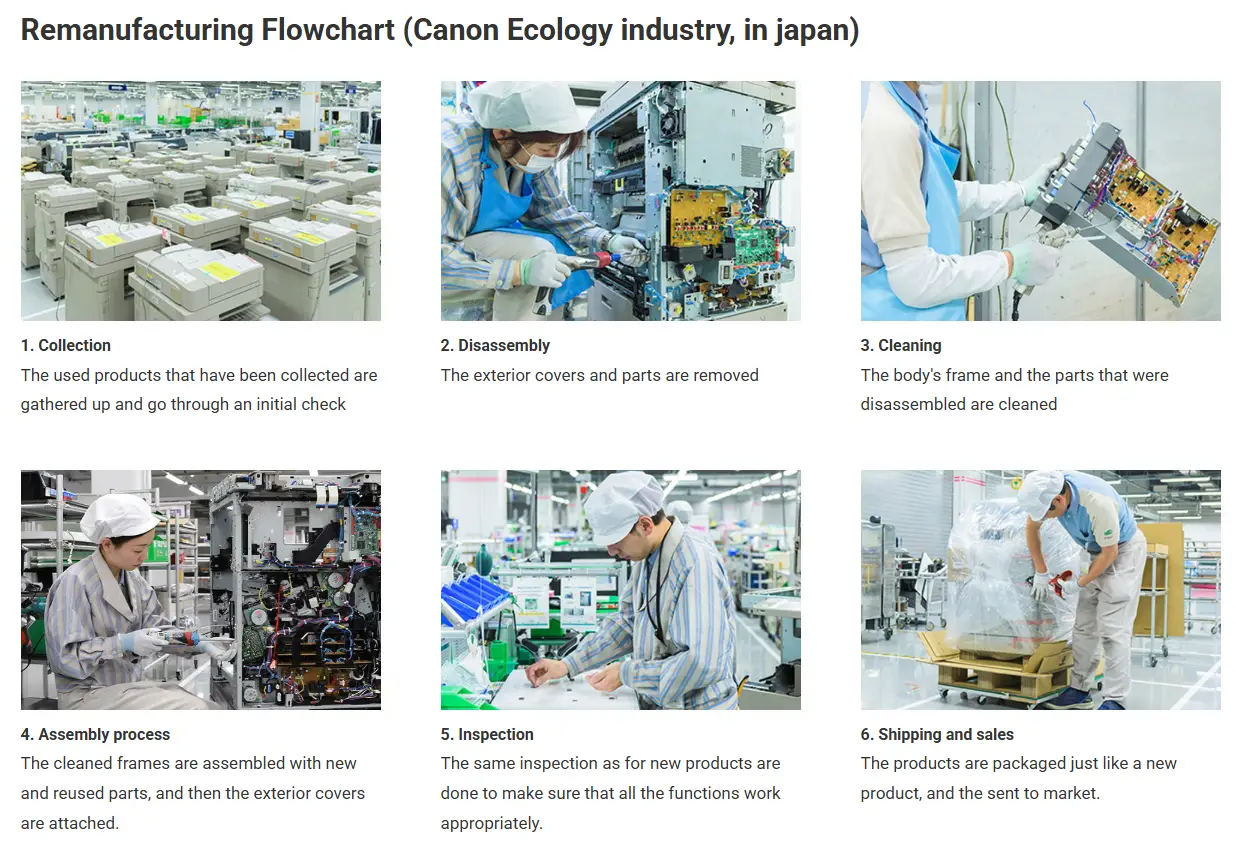
The strategic rationale for this vertically integrated approach includes several factors. Maintaining control of the process protects Canon’s intellectual property and engineering standards. Factory remanufacturing also enables OEM-level quality assurance, ensuring that remanufactured devices meet the same reliability standards as new equipment. Finally, it allows Canon to capture economic value that historically flowed to independent refurbishers and brokers in the secondary equipment market.
Canon will likely position these machines as “certified remanufactured” or “factory rebuilt” equipment offering:
- full OEM warranty
- new consumable assemblies such as drums, developer units, and rollers
- pricing below the new equipment
- availability primarily through Managed Print Services contracts.
Lifecycle Extension
Factory-scale remanufacturing has important implications for the lifecycle of office equipment. Traditionally, copiers operate for approximately five years during a typical lease period before being replaced with new machines. After the first lifecycle ends, the equipment is refurbished for resale or exported to secondary markets.
Remanufacturing introduces a more circular lifecycle:
-
Traditional:
- New → Lease return → Refurb/export/scrap (5 years)
-
Circular:
- New → Remanufactured → Second use (8-10 years total). This slows new purchases but aids financial and sustainability benefits.
Target Devices
In Canon’s portfolio, many potential candidates come from the imageRUNNER ADVANCE platform. These machines share modular architecture, allowing major assemblies, including fusers, developer units, and scanners, to be replaced or reused efficiently. Millions of these devices have been deployed across North America, providing a steady supply of lease-return machines suitable for remanufacturing.
U.S. Office Equipment Industry Impact
For decades, the U.S. market has supported a robust ecosystem of aftermarket companies specializing in the rebuilding of off-lease copiers. These firms typically acquire used machines from dealers or leasing companies, refurbish them, and resell them domestically or export them to emerging markets. If manufacturers reclaim a greater share of returned devices for factory remanufacturing, the availability of high-quality lease-return equipment for independent operators may decline.
Remanufactured machines can significantly reduce the capital cost of hardware deployed under MPS contracts while maintaining reliable performance. This allows providers to improve margins or offer more competitive pricing while extending the operational life of equipment.

Environmental considerations are also increasingly important. Many corporations and government agencies now evaluate the carbon footprint and lifecycle sustainability of the equipment they procure. Remanufactured devices align well with these objectives because they reuse major structural components—such as steel frames, motors, and mechanical assemblies—rather than manufacturing entirely new units. As a result, they can significantly reduce the environmental impact associated with raw material extraction, manufacturing, and transportation.
U.S. Challenges and Shifts
The United States has historically been one of the most challenging markets for OEM remanufacturing programs, largely due to the strong independent dealer network. Dealers purchase equipment from manufacturers and generate revenue from three primary sources:
- hardware sales
- service contracts
- consumables and supplies.
If remanufactured machines extend equipment lifecycles from approximately five years to eight or ten years, dealers may sell fewer new machines. For this reason, dealer channel economics have historically been one of the largest barriers to OEM remanufacturing programs.
U.S. buyers have often associated “remanufactured” equipment with used products, while “new” machines were perceived as more reliable. However, OEM-branded remanufacturing will disrupt this model by reclaiming returned machines before they enter the secondary market. Canon will likely emphasize sustainability and lifecycle efficiency rather than positioning the equipment simply as used machines.
Several recent developments are making the U.S. market more receptive to OEM remanufacturing:
- Print volumes have declined significantly since the widespread adoption of hybrid work following the COVID-19 pandemic. Printer and copier fleets have been downgraded, so remanufactured devices could provide a lower-cost alternative.
- The growth of Managed Print Services has shifted customer priorities. Customers demand reliable output and predictable cost per page and are not as concerned about whether the device is new or remanufactured.
- Many organizations now require suppliers to demonstrate carbon reduction strategies and support circular economy principles. Remanufactured hardware directly supports these goals.
Together, these factors have weakened many of the barriers that previously limited OEM remanufacturing in the U.S. market.
Broader Effects
The United States is the largest source of used copiers in the world due to its heavy reliance on leasing. Consequently, large numbers of lease-return machines are refurbished and exported to Latin America, Africa, Eastern Europe, and Southeast Asia, where lower-cost office equipment is in strong demand.
If manufacturers reclaim a greater share of lease-return machines for factory remanufacturing, the supply of equipment available to exporters could decline. This may increase prices in the global used copier market and shift more of the economic value from independent refurbishers to original manufacturers.
While the aftermarket cartridge industry is unlikely to disappear entirely, OEM-controlled remanufacturing could gradually shift the balance of the consumables market back toward original manufacturers as well.
Strategic Outlook
By integrating remanufacturing with its existing cartridge and component manufacturing operations in Virginia, Canon’s U.S. is effectively creating a regional circular production ecosystem in North America.
If the program proves successful, other manufacturers, Ricoh, Xerox, Konica Minolta, and potentially HP, may also establish similar initiatives in the United States.
By reclaiming returned machines and rebuilding them within its own manufacturing ecosystem, Canon is moving toward a more vertically integrated lifecycle model. Canon’s U.S. initiative represents more than a sustainability program; it reflects a shift toward greater OEM control over the entire lifecycle of office equipment.
If successful, this approach could reshape the global copier and printing market by reducing the flow of used machines to third-party refurbishers. Over the next decade, the key question will be whether other major OEM manufacturers follow a similar path toward OEM-controlled circular manufacturing in the U.S. market.
About the Author
 Graham J. Galliford is a world-renowned consultant to the imaging industry. His work has encompassed the technology of all types of printing products but has been focused on toner-based printing technology since 1974. He founded Galliford Consulting & Marketing, a techno-commercial consulting business concerning toner-based imaging processes, in 1994. The firm’s particular emphasis is on digital printing with electrostatic toner.
Operating from a unique facility for R&D on digital printing materials his business has completed many projects concerning the formulation, manufacture, application and marketing of these products. Galliford has been a regular speaker at conferences in North America, Europe and Asia on all aspects of the digital printing and the toner business from technology to marketing to manufacturing. He has made over 80 presentations to industry gatherings over the last 30 years, including seminars on digital printing technologies and chemically prepared toner technology and markets. He can be contacted by email at graham@ gallifordconsulting.com
Related:
- Toner Cartridge Manufacturers Guarantee Great Color for Their Customers
- The Role of a Bill of Materials in Costings and Pricing
- Digging Deeper into Inkjet Ink Market Share
- Manufacturing Color Toner – Who How and Where
- Supply Chains and Market Integration
- Debate: Toner & Laser Supplies Will Continue to Dominate
- Testing Cartridge Components and Meeting Standards
- The Controversy Over Cartridge “Contaminants” – An Attempt to Avoid Bias
- Facts and Lies over the Toxins in Your Printer Cartridges
- Why Most OEMs Are Japanese
Comment:
Please comment below about this feature article, “Canon’s U.S. Remanufacturing Initiative and Industry Implications.”



Leave a Comment
Want to join the discussion?Feel free to contribute!