 Sunday, August 2, 2026
The Changing Face of SMB Buying Habits
The Changing Face of SMB Buying Habits
—How SMBs Are Maximising Digital Tools for Convenient Online Purchasing
The dynamics of hardware purchasing have changed dramatically over the last 20 years. That’s to be expected because nothing stays the same for very long. And as technology evolves to enable prospective buyers to interact with the marketplace, it is to be expected that the habits and trends prospects use to make their purchase decisions have also changed.
The maturity of e-commerce to purchase print and scan hardware means that OEMs and vendors must deploy nimble, targeted marketing strategies to attract attention to their products. Dealers also must ensure their value proposition is clear, concise, and reaches the right audience.
Let’s explore how the purchasing landscape has changed, what is driving SMB purchasing, the customer purchasing journey, and the role of social media in the purchasing journey, all while drawing insights from Keypoint Intelligence’s latest research study.
The Plates Are Always Shifting: How the Purchasing Landscape Has Changed
The purchasing landscape for print and scan has always been competitive, but as online marketplaces and e-commerce alternatives to traditional models have flourished, that landscape has become narrower and even more fierce. Traditional buying-cycle models, lasting 3-5 years, once dominated the industry, driven by the replacement of equipment as new models came to market, regardless of whether the equipment needed replacement or not. This has changed. Buying cycles, particularly with scanning, have increased to 5-7 years, and purchases are driven by upgrading equipment rather than replacing it.
Since the pandemic, we have seen the conflation of personal and business-related use for print and scan devices. Naturally, those who are self-employed or work for a micro business are more likely to use a device for both personal and work jobs, but we are seeing an increase in people using business devices for personal use in SMB settings too. Conventions that became normalized during the pandemic, like buying a device for work and personal use at home, have now evolved to affect devices being bought for and kept in the office.
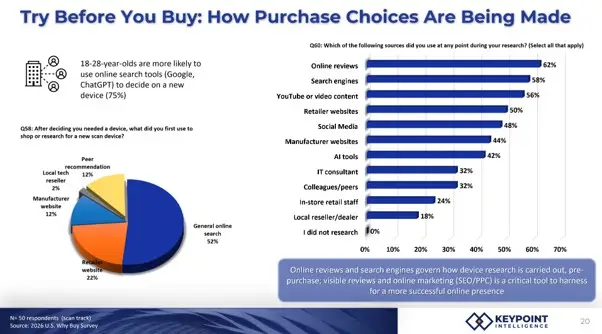
The online marketplace now dominates final transactions. In Keypoint Intelligence’s recent survey analysing current purchasing trends, over a third of respondents stated that they purchased exclusively via an e-commerce site such as Amazon. When prospects conduct research for new devices, however, the picture becomes more fragmented—most of the activity takes place digitally, it must be said. General searches, retailer sites, online reviews, video manufacturing content, social media commentary, and artificial intelligence (AI) tools are all used by prospects during the research process, making it more difficult for OEMs and vendors to ensure their messaging is reached across all online touchpoints.
Sustainability is far more embedded in the consciousness of prospective buyers than the industry might think. Previously seen as a more niche concern when compared to factors such as total cost of ownership (TCO), reliability, and energy efficiency, sustainability is extremely important to prospective buyers when considering if the device can be recycled at end-of-life, how much reused plastic it contains, and whether the supplies it uses can also be recycled effectively. OEMs and vendors, therefore, cannot afford to take focus away from their sustainability practices when devising marketing strategies for new products.
It will count against them during purchasing research.
The Purchasing Process
Keypoint Intelligence’s recent study into purchase trends and the customer journey has revealed many interesting points about the print and scan purchasing processes. Buyers are typically mid-career operational decision makers rather than younger, and perhaps more digitally savvy. The key age range is 29-44 years old.
Purchasing, therefore, seems to be tied to operational authority. Hardware purchases seem to be viewed as workflow infrastructure needs: Standalone hardware is the entry point that feeds into bigger software and workflow infrastructure needs. Hardware setup and onboarding determine engagement with the OEM or vendor, and this then determines the loyalty the purchaser will show to them in the future. For OEMs and vendors to build relationships with purchasers and provide solutions and services for the long term, their focus must be on ensuring that the hardware they provide works for the prospect.
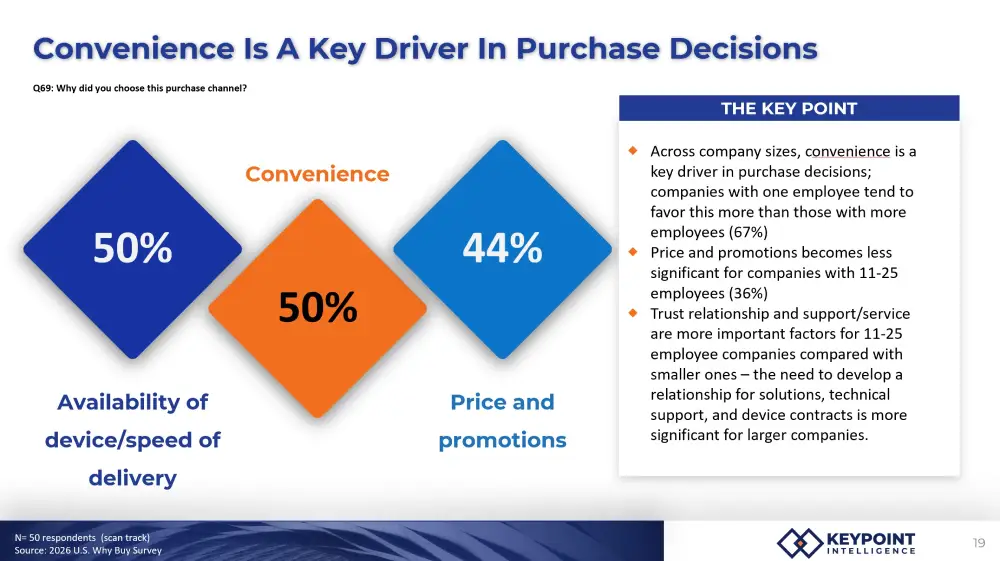
Because most transactions happen through e-commerce sites, the most important buying factors are availability, speed of delivery, and the convenience of the process. When a device is needed quickly, particularly for businesses with 1-2 employees, the process moves quickly, with the expectation of efficiency. This trend also highlights another key factor: We are creatures of habit, so if buying online worked well in the past, we are more likely to revert to the same method again.
Supplies follow the same trend lines. Convenience is often favoured over price, and the online marketplace is where most supplies purchases take place. Buyers seldom stay with the original supplier of the hardware and supplies such as ink and paper; they will shop around for those that offer the best price and convenience of ordering and delivery. Paper is more versatile in terms of channels used for purchasing as not everything is focused on e-commerce—but quality is the determining factor, not price.
The Role of Social Media
Social media has been instrumental in marketing products to SMBs and influencing buying decisions. The recent trend shift, however, can be seen in SMBs not wanting to be “sold to” but rather informed of how a product performs in specific real-world settings or conditions. With social media content, particularly short-form video content, being used extensively for research before a purchase, OEMs and vendors must stay ahead of the curve by using this medium to inform prospects about their products rather than just present a sales pitch. Honest, straightforward testimonial-style content builds trust with prospects and encourages them to conduct further research. Using social media content in this way will enable OEMs and vendors to nurture more targeted and more secure leads.
Final Thoughts
The customer journey for hardware purchasing continues to evolve. Social media content and online reviews are driving prospect research and knowledge quests. OEMs and vendors do not always have full control over how information about their products is being consumed. To stay relevant, OEMs and vendors need to ensure their marketing strategy is flexible and can adapt, depending on how prospects respond to the information they find on specific devices. Their brands and products are always on show, and ensuring they are always presented in the best light is paramount.
OEMs and vendors must also consider that factors such as company size and job function will also influence prospect’s purchasing decisions. As part of our research into buyer journey, we have tracked the importance of these personas based on different factors to see where OEMs and vendors need to tailor messaging to suit these different prospects. Companies of varying size will prioritise different purchasing factors: Individuals favour TCO, whereas SMBs look at device feature sets, but this means dynamic marketing campaigns are needed to target the sweet spot of the swath of purchasing groups.
Winning brand loyalty is key. And once prospects settle on a brand, they are loyal to that brand, so earning that loyalty is the most important task of the OEM or vendor.
About the Author
 Dr. Mark Davis is an analyst at Keypoint Intelligence specializing in document scanning technologies and document capture solutions. He conducts product evaluations and research to assess device performance and trends in the document scanning market, bringing a strong analytical perspective supported by advanced degrees in English literature and critical and creative writing.
Related:
The OE Channel Migration: From Hardware Transactions to Digital Transformation
Comment:
Please leave your comments for the story “The Changing Face of SMB Buying Habits.“


Leave a Comment
Want to join the discussion?Feel free to contribute!