 Sunday, June 28, 2026
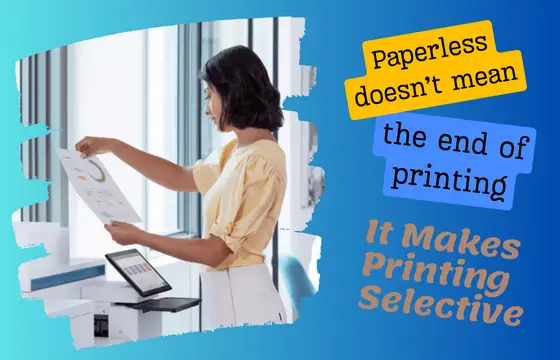
Paperless Doesn’t Mean the End of Printing—It Makes Printing Selective
Paperless and digitalization are nothing new to many in the industry. Yet rather than eliminating print, they are reshaping it, with different countries and different sectors experiencing the transition at different speeds.
According to Cecile Zheng, Deputy General Manager of the RemaxWorld expo organizer, printing under the paperless trend is becoming more selective rather than simply disappearing. Take paperless initiatives in New Delhi’s legislative departments as an example: while the majority of documents are now handled digitally, printing remains unavoidable in specific scenarios.
From her observations, low-value printing is gradually fading out. In contrast, official, record-based, and compliance-related printing is becoming more critical and demanding than ever before.
This view is echoed by India-based industry professional Dhruv Mahajan. Based on his experience in the Indian market, routine and informal printing is steadily reducing, while print linked to regulated sectors such as government, banking, healthcare and education remains highly active. In many cases, it has also become significantly more quality-sensitive than before.
In regulated sectors, printing is not merely an operational choice; it is a compliance requirement. In many jurisdictions, legal accountability, audit trails and document authenticity still rely heavily on physical records.
As overall print volumes decline, tolerance for errors drops faster. In government, banking or healthcare environments, a failed or inconsistent print is no longer a minor inconvenience—it represents a potential risk.
For many regulated organizations, the real challenge is no longer whether digital systems exist, but whether the cost, risk and disruption of replacing established workflows can be justified.
Selective printing also introduces a new reality: higher expectations for printing quality and related services.
In price-sensitive Indian market, Mahajan notes that customers are now placing greater emphasis on sharper output, consistency, durability, and reliability, rather than focusing solely on cost per print. As a result, cartridge and consumables performance have become even more critical, since failures or inconsistencies are far less acceptable when printing high-stakes documents.
What Selective Printing Means for the Industry
For Aftermarket Suppliers
In selective printing environments, risk per page is increasingly replacing cost per page as the dominant factor in clients’ decision-making.
As printing volumes shrink, clients naturally become more concerned with quality, reliability, and failure risk—particularly in high-risk applications. This requires aftermarket suppliers to redefine their quality standards, not only in terms of output, but also in consistency and reliability over time.
At the same time, aftermarket suppliers need a much clearer segmentation of application scenarios. Investing in more vertically specific production lines and serving clearly defined customer groups will become more important than attempting to serve all markets at once. Overall, the industry strategy is likely to shift from a full-scale expansion toward a contraction-driven upgrading.
For Channel Players
Selective printing will not eliminate distribution channels. It is only accelerating channel differentiation.
As overall printing demand declines, margins in traditional transaction-based channels will continue to be squeezed. In contrast, industry-specific channels focused on regulated sectors such as government, healthcare, and education, and on integrated solutions rather than standalone products, are more likely to remain resilient.
In a time of selective printing, customers are primarily asking two questions:
- Which documents must be printed, and which can be fully digitized?
- Which printing requirements cannot be compromised?
Channel players that can help answer these questions will evolve from simple suppliers into trusted partners.
For Service and Solution Providers
Print less means that every print matters more than ever before. Under this condition, customers are more willing to invest in services that offer operational stability, risk control, and compliance assurance.
As a result, service portfolios must evolve beyond basic device maintenance. Instead of focusing solely on consumables replacement and hardware repair, service providers will need to expand into document process consultancy, regulated document management, print access control, and audit and tracking solutions.
Altogether, paperless transformation does not eliminate print demand—it reshapes and intensifies it.
Selective printing seems to be growing rather than fading, as regulatory requirements become stricter and document environments more complex. Organizations now rely on fewer but more critical print workflows, where reliability, traceability, and service capability matter most.
The main point is to view paperless initiatives realistically, without exaggerating their speed or impact, and approach them with strategic clarity. The future of printing will be defined less by volume and more by value, risk, and relevance.
What’s your take on the paperless trend? Share your comments below.
 Maggie Wang has been delivering valuable information and updates about the imaging industry through RT channels (website, magazines, and social media platforms) during the past 10 years. She has also extensively covered major events such as the annual RemaxWorld Expo and VIP Imaging Expos through press releases, articles, and interview videos. She can be contacted at <Maggie.Wang@rtmworld.com>.
Related reading:
- Japan’s Journey to Paperless: Digitization and the Decline of Office Printing
- The Inevitable Decline of Postal Services in a Paperless World
Commment:
Please leave your comments below on the story <Paperless Doesn’t Mean the End of Printing—It Makes Printing Selective>.








Leave a Comment
Want to join the discussion?Feel free to contribute!