 Wednesday, August 5, 2026

Canon’s Copier Bet—and What China’s Challengers May Write Next
Canon’s Copier Bet—and What China’s Challengers May Write Next
In Japan, one of the most closely followed business features is “Watashi no Rirekisho” (“My Résumé”), a long-running autobiography series that typically runs for an entire month, allowing a single prominent figure to recount their life in their own words. In early 2026, the series turned its spotlight to Canon’s Fujio Mitarai (pictured right), giving Japan’s office supplies community something rare: a sustained, first-person window into the instincts, decisions, and scars of a top leader who helped shape a global imaging business.
That month-long “leader’s voice” matters beyond Japan—because the industry is watching another generation of challengers rise. And if history rhymes, today’s Chinese printer makers may be living through their own defining chapters right now—chapters their future leaders might one day describe just as candidly.
“Cameras in the Right Hand, Business Machines in the Left”: The Strategic Starting Line
Canon’s full-scale commitment to business machines is often traced to a defining internal message announced around its 30th anniversary: “Cameras in the Right Hand, Business Machines in the Left.” Canon’s corporate history records the slogan in 1967, signaling a deliberate push beyond cameras toward office equipment.
The timing was not convenient. In the plain-paper copier (PPC) market, Xerox dominated. More importantly, xerography and its extensive patent portfolio created a formidable barrier to entry. For a latecomer, the obvious route—copying the incumbent architecture—was not a route at all. Canon’s premise was simple: compete globally by building an original process that avoided infringing the incumbent’s core patents.
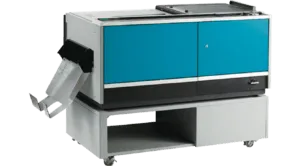 That decision produced Canon’s NP (New Process) system, culminating in the launch of the NP-1100 in 1970, a plain-paper copier based on Canon’s proprietary approach.
NP Was More Than “Avoidance”—It Became a Platform
NP is sometimes summarized as an “alternative” electrophotographic process. However, the enduring lesson is how Canon used constraints. Designing around patents forced rethinking at multiple layers—materials, image formation, and cleaning mechanisms—rather than tweaking a single component.
A frequently cited example is Canon’s photoreceptor cleaning invention, widely known as the blade cleaner. Canon highlights this cleaning concept as a revolutionary NP-related invention, which later became broadly used across copier manufacturers.
In other words, constraint-driven engineering didn’t merely clear an IP hurdle; it generated a technology element that became industry-standard. That distinction is crucial for any manufacturer trying to build a lasting imaging business:
Avoidance design keeps you out of court.
Platform design keeps you in the market.
The Turning Point: Small, Affordable, Simple (NP-200J and Jumping Development)
Technical independence does not automatically equal commercial success—particularly in the US market, where dealer networks, service expectations, and competitive messaging can overwhelm a newcomer’s engineering narrative.
Canon’s commercial inflection point came in 1979 with the launch of the NP-200J, described by Canon as the world’s first plain-paper copier equipped with the jumping development method (dry type). Canon explains that jumping development forms images by flying insulating toner to the electrostatic latent image in a non-contact state, enabling a simpler configuration that supported dramatic downsizing and lower cost, and that the technology later became a key method applied across copiers and laser printers.
The market meaning is clear: Canon translated engineering into a product proposition that buyers and dealers could sell.
- Smaller footprint, broadened placement, and customer reach.
- Lower price expanded the addressable market beyond traditional copier-heavy offices.
- Simplified mechanisms reduced friction in operation—and, ideally, service.
This was the step from “we can build it” to “the channel can move it.”
 The Part That Looks Like a Footnote—Until It Almost Ended Everything
Every office equipment manufacturer eventually learns a harsh truth: quality problems are not only technical events; they are channel trust events.
After NP-200’s success accelerated growth, the next phase brought an unexpected challenge: performance issues in extreme cold and low humidity—conditions that can amplify electrostatic side effects and reveal failure modes that lab environments do not fully replicate.
When dealer frustration escalates, the business faces a credibility cliff. At that moment, the differentiator is not a datasheet. It is leadership.
Why Leadership and Channel Trust Decide Outcomes
Fujio Mitarai—who would later become Canon’s top executive—served on the frontline in the US operation. Public profiles note that he became president of Canon’s US business in 1979.
The leadership lesson from this era is practical for any brand that depends on dealers:
- Dealers invest in inventory, service capability, and local reputation.
- A vendor’s quality instability threatens that investment directly.
- If dealers stop believing the vendor will stand behind the product, the route-to-market collapses.
That is why the most important currency in channel markets is not margin—it is credibility under pressure.
Why This Matters Now: The “Canon vs. Xerox” Moment is Echoing in Printers
Fast-forward to today. Several Chinese printer manufacturers are moving from local contender to global participant, often by:
- Studying incumbent architectures and patent landscapes closely,
- Building differentiated designs and brands while managing litigation risk,
- Entering through value segments (SMB and developing markets) with competitive pricing and “good enough” performance.
This resembles Canon’s historical posture crucially: distinguishing what is truly protected (patent claims) from what is merely conventional wisdom (industry habits). Canon’s NP approach shows how systematically decomposing the incumbent’s “system” can lead to a new technology stack rather than a superficial clone.
But Canon’s history also warns what comes next.
The Next Wall Chinese Printer Makers Will Hit
As these manufacturers scale internationally, they will almost certainly encounter the same “second-order” problems:
- Environmental variability (temperature/humidity extremes, power quality, media variability),
- Channel friction (service capability gaps, warranty disputes, parts logistics),
- Brand trust volatility (one failure can reset years of progress),
- Legal and geopolitical risk (patent assertions, regulation, trade pressure).
The core lesson is simple:
Technical wins get you into the market.
Channel trust keeps you there.
That trust is built through operations: transparent field feedback loops, fast corrective actions, parts availability, training, and leadership willingness to own the problem in public.
A 20-Year Thought Experiment: The Memoirs We May Read Next
Japan’s industry readers are glued to a top leader’s autobiography because it turns corporate history into usable operating lessons—how decisions were made, how trust was won or lost, and what it cost to keep going.
Now imagine the same format two decades from now: the founder or CEO of a Chinese printer challenger writing a candid month-long series about today’s global expansion—how the company navigated IP minefields, service realities, channel tensions, and reputational crises in unfamiliar markets.
If that happens, it will likely confirm the oldest rule in imaging: technology evolves, markets shift—but the difference between a rising brand and a cautionary tale is how leaders respond when reality hits.
About the Author
 Koichi Yoshizuka is the founder and CEO of QRIE Ltd., established in 2005. QRIE specializes in importing and wholesaling compatible inks and toners for printers. The company has successfully expanded into online sales through its e-commerce site and major platforms like Rakuten, Amazon, and Yahoo! Shopping, serving a diverse clientele ranging from corporate clients to individual consumers. Renowned for quality and affordability, QRIE has won Rakuten’s Shop of the Year award in the Electronics category three times.
In addition, QRIE is actively developing new digital businesses and products driven by employee innovation. Today, QRIE boasts annual sales revenue of approximately USD 14 million and employs 45 dedicated staff members. Under Koichi Yoshizuka’s leadership, QRIE continues to thrive and innovate in the competitive printer supplies market.
Koichi Yoshizuka was also a featured speaker at the RemaxWorld Summit 2024, held in October during the RemaxWorld Expo in Zhuhai, China. In his address, he highlighted the unique characteristics of the Japanese printing and copying market.
For communication, you can contact Koichi Yoshizuka on LinkedIn.
Other posts from Koichi:
- Why Global Tech Trends Signal a Wake-Up Call for the Aftermarket — Lessons from CES 2026
- Canon Marketing Japan’s Valuation Surge: Lessons for the Aftermarket
- What ASKUL’s Pivot Teaches Us About Surviving a Shrinking Market
- Japan’s Journey to Paperless: Digitization and the Decline of Office Printing
- The Inevitable Decline of Postal Services in a Paperless World
- How Tokyo’s Digital Reform Threatens Japan’s Office Supply Industry
- Japan’s Digital Address Revolution Reshapes Logistics
- Japan Post’s ¥370 Billion Logistics Overhaul: Implications for QRIE and the Wider Printing Supplies Industry
Comment:
Please leave your comments below for the story “Canon’s Copier Bet—and What China’s Challengers May Write Next.”




Leave a Comment
Want to join the discussion?Feel free to contribute!