 Thursday, April 2, 2026
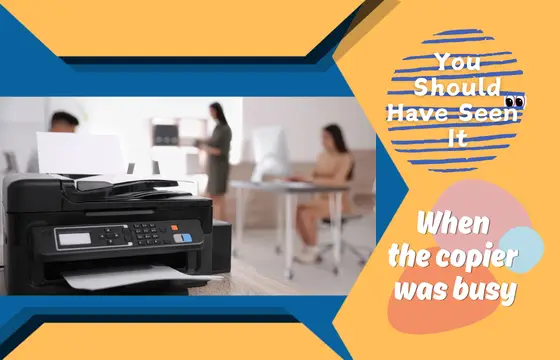
You Should Have Seen It When the Copier Was Busy
For most of my career, the small office copier was the center of the business.
I still remember walking into offices early in my career, and the copier would be the first thing you noticed. You didn’t have to ask where it was; you could hear it. The machine would be humming away, someone standing there waiting for their copies, someone else trying to figure out why their job jammed. There was almost always a stack of originals sitting on top of the feeder. That copier wasn’t just a machine; it was the heartbeat of the office.
Everything seemed to happen around it. Contracts were copied there, proposals were assembled there, and invoices were duplicated there. And now and then, someone would make a personal copy of something and glance around the room like they were committing a crime. If the copier went down, the whole office felt it. Work slowed, people complained, and somebody inevitably called the service number written on the sticker on the front of the machine.
Back then, every business needed one. No question about it.
Something Changed
But something interesting has been happening over the last fifteen years, and if you’ve been in enough offices as I have, you start to notice it. The copier is still there when you walk in, but it’s quiet. In many small offices, the machine that once ran all day might print a few hundred pages in an entire week. Years ago, that same office might have run 8,000 pages a month without even thinking about it.
Sometimes I stand there looking at the machine and almost feel bad for it. It reminds me of a retired athlete sitting on the bench thinking, “Coach… I can still play.” The reality is that the game moved somewhere else.
Today, a document is usually created on a laptop. It gets shared in the cloud, edited by a few people, signed digitally, and stored in a system somewhere that nobody can quite remember how to search six months later. The copier often never enters the picture. What used to be the first step in the workflow has quietly become the last step, if it happens at all.
The Shift
And recently, I’ve seen something else that really made this shift feel real. In just the past few months, two of my clients called me, both good accounts and both companies I’ve worked with for years. When I saw their names pop up on my phone, I figured we were going to talk about replacing a machine or renewing a lease.
Instead, both conversations went something like this. “Art, we’re going fully remote. Everyone is working from home now. We’re closing the office… and honestly, we don’t need the copier anymore.” You sit there on the other end of the phone for a moment and realize the conversation isn’t about price, service, or equipment.
The copier just isn’t part of the business anymore. And it made me wonder something. How many other copier salespeople have gotten that same call recently? Probably more than we talk about.
The funny thing is, the biggest companies in our industry already know this. They just don’t always say it out loud on the trade show floor. If you listen closely to how they talk about themselves today, you’ll notice something has changed.
OEMs
Ricoh doesn’t lead with copiers anymore. They talk about digital workplace services. Xerox talks about automation and software platforms. Kyocera talks about document solutions and workflow ecosystems. They still make copiers, of course, but the copier isn’t the headline act anymore. It’s more like the bass player in the band, important, but not the lead singer.
Then recently, something happened that really made me stop and think.
HP, the company that practically invented the office laser printer, announced it will shut down its historic LaserJet operation in Boise, Idaho, and exit the site by 2027. That campus dates back to the 1970s and was where engineers developed the LaserJet printer that changed office printing forever. At one point, thousands of people worked there, and even today, about 1,100 employees tied largely to the LaserJet division are still based at the facility.
Think about that for a second. The birthplace of the LaserJet printer is closing its doors. That’s like Ford shutting down the plant where the Mustang was invented.
HP says the move is part of a larger strategy to consolidate operations into a smaller number of technology hubs, but when viewed from the perspective of someone who has spent decades in the industry, it feels like something more significant.
It feels like the end of an era. When a company begins closing the chapter on something that iconic, it usually means the market has already started moving in a different direction.
The market is moving
When I walk into small offices today, I hear the same question more and more often. Someone eventually points to the copier and says, “Why do we even have this thing?” And honestly, sometimes it’s a fair question.
Why place a $6,000 to $10,000 A3 copier in an office that prints a few hundred pages a month? Why maintain a service contract on a machine that mostly sits there waiting for someone to press the start button? It’s a little like owning a pickup truck when all you do is drive to the grocery store. It might look impressive in the parking lot, but you’re not really using it.
Some small offices are already making the change. They replace the big copier with a smaller multifunction printer. Some move printing to a central office hub. Some eliminate printing almost entirely. And once AI begins routing documents automatically, handling approvals, indexing files, and storing everything in digital systems, the need for paper will shrink even more.
Now, don’t get me wrong. Printing isn’t disappearing tomorrow. I work with architects and engineers every day, and they still love their drawings. Wide-format printers are not going away anytime soon. There are industries where paper is still part of the job, legal, healthcare, government, construction. In those environments, print still matters.
But the SMB copier, the traditional A3 machine sitting in a small office with five or ten employees, is slowly becoming something else. It’s becoming a relic of how offices used to operate, a little like the fax machine.
Remember When
Remember when every office had one of those? For years, they sat there long after email had replaced them. Eventually, someone unplugged it, and after a while, nobody even noticed.
Copiers in small offices are beginning to feel a little like that. And for those of us who built our careers selling copiers, it’s a strange thing to watch. I’ve spent decades walking into offices talking about speed, paper trays, finishers, copy quality, and service response times, all the things that used to matter. Those conversations built an entire industry.
Truth
But the truth is, the future of our industry isn’t the page anymore. It’s what happens around the page. Workflow automation, intelligent document processing, cybersecurity, and digital document management are becoming the real center of the conversation. What happens when the last page is scanned?
The companies that will lead the next twenty years won’t be copier companies in the traditional sense. They’ll be workflow and robotic companies that happen to sell copiers when needed.
And one day, I suspect someone will walk into a small office, look at that quiet copier sitting in the corner, and say something like, “Did people really use to run an entire business around that machine?”
The old guy in the room, probably someone like me, will smile and say, “Oh yeah. You should have seen it when it was busy.”
Prepare for the end of print with SMB, it’s closer than you think.
*This article is republished from Art Post’s LinkedIn with permission. Is the trend limited to the U.S. market, or is it happening in your market too? Share your comments below.
 About the Author
Art Post has spent more than 46 years in the office technology industry, helping businesses improve how they print, manage, and process documents. Based in New Jersey, he specializes in copiers, wide-format printing, and workflow solutions for engineering, architectural, and construction firms. Art is also the founder of the Print4Pay Hotel community and a regular industry writer focused on the evolution of managed print, AI, and emerging technologies such as robotics in the office technology channel. He is passionate about helping dealers and businesses adapt to the future of work and automation.
Related:
Canon’s Copier Bet—and What China’s Challengers May Write Next
Comment:
Please leave your comments below for the story “You Should Have Seen It When the Copier Was Busy.“


Leave a Comment
Want to join the discussion?Feel free to contribute!